Chijin
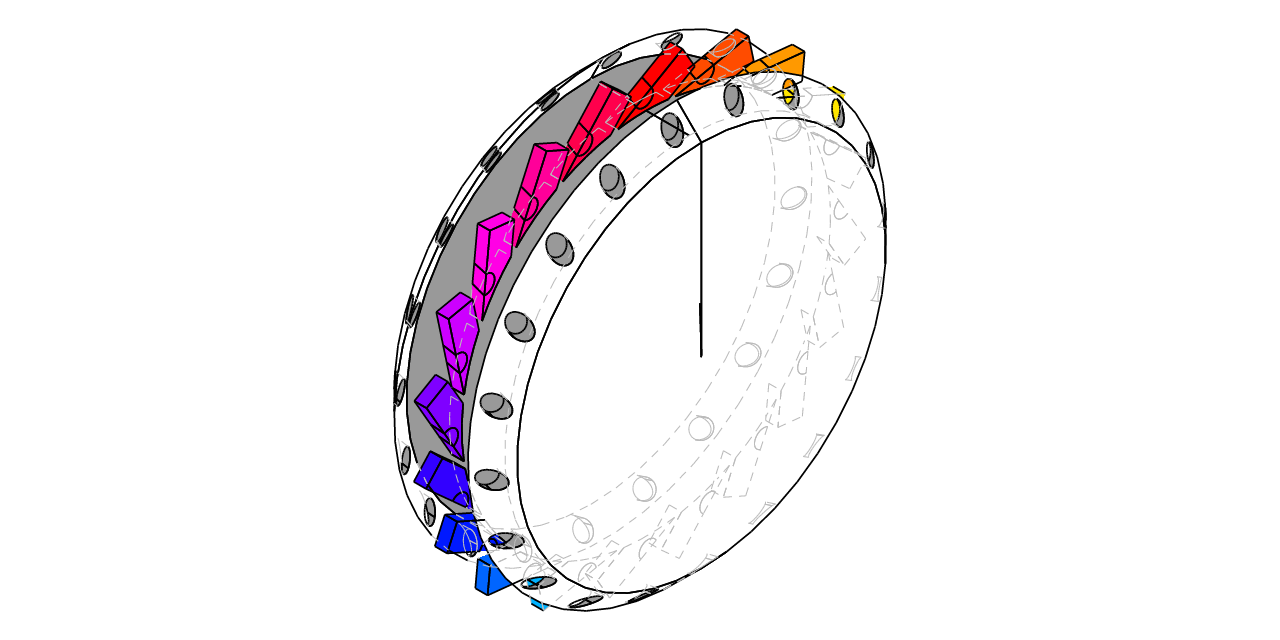
Build a chijin (hand drum from Amami Oshima) with colors, boolean ops, and SVG export.
//! Build a chijin (hand drum from Amami Oshima) with colors, boolean ops, and SVG export.

use cadrum::{Color, DVec3, Edge, ProfileOrient, Solid};
use std::f64::consts::PI;

/// Paint every face. A face colour outranks the solid colour, and boolean ops carry it
/// via history, so it survives where `Solid::color` (the whole solid) would be overwritten.
fn color_faces(mut solid: Solid, color: impl Into<Color>) -> Solid {
	let c = color.into();
	let ids: Vec<u64> = solid.iter_face().map(|f| f.id()).collect();
	for id in ids {
		solid.colormap_mut().insert(id, c);
	}
	solid
}

fn chijin() -> Result<Solid, cadrum::Error> {
	// ── Body (cylinder): r=15, h=8, centered at origin (y=-4..+4) ────────
	let cylinder = Solid::cylinder(15.0, DVec3::Y * 8.0).translate(DVec3::Y * -4.0).color("#999");

	// ── Sheet: closed polygon in the XY plane (z=0), swept 360° around Y
	// により面と縁を一体で生成する。Face::from_polygon + Face::revolve の置換版:
	//   - Edge::polygon は最後の点 → 最初の点を自動補完して閉じる
	//   - spine は Y 軸まわりの円。半径によらずプロファイルを Y 周りに純粋回転
	//     させるだけなので任意の正の値で可
	//   - ProfileOrient::Up(Y) でプロファイルの上方向を Y 固定 → 回転(revolve)と等価
	let cross_section = Edge::polygon(&[DVec3::new(0.0, 5.0, 0.0), DVec3::new(15.0, 5.0, 0.0), DVec3::new(17.0, 3.0, 0.0), DVec3::new(15.0, 4.0, 0.0), DVec3::new(0.0, 4.0, 0.0)])?;
	let spine = Edge::circle(1.0, DVec3::Y)?;
	let sheet = color_faces(Solid::sweep(&cross_section, &[spine], ProfileOrient::Up(DVec3::Y))?, "#fff");
	let sheets = [sheet.clone().mirror(DVec3::ZERO, DVec3::Y), sheet];

	// ── Lacing blocks: 2x1x8, rotated 60° around Y, placed at z=15 ──────
	let block_proto = Solid::cube(DVec3::ZERO, DVec3::new(2.0, 1.0, 8.0)).translate(DVec3::new(-1.0, -0.5, -4.0)).rotate_y(-60.0_f64.to_radians()).translate(DVec3::Z * 15.0);

	// ── Lacing holes: thin cylinders through each block ──────────────────
	let hole_proto = Solid::cylinder(0.7, (DVec3::X * 10.0 + DVec3::Y * 30.0).normalize() * 30.0).translate(DVec3::new(-5.0, -15.0, 16.0));

	// Distribute N blocks and holes evenly around Y, each block in a rainbow color
	// N 個のブロックと穴を Y 軸周りに等間隔配置、各ブロックに虹色を割り当て
	const N: usize = 20;
	let angle = |i: usize| 2.0 * PI * (i as f64) / (N as f64);
	let color = |i: usize| Color::from_hsv(i as f32 / N as f32, 1.0, 1.0);
	let blocks: [Solid; N] = std::array::from_fn(|i| color_faces(block_proto.clone().rotate_y(-angle(i)), color(i)));
	let holes: [Solid; N] = std::array::from_fn(|i| hole_proto.clone().rotate_y(-angle(i)));
	// ── Assemble with boolean operations: union, subtract, union ─────────
	let mut result: Solid = (&cylinder + &sheets[0] + &sheets[1]).build()?;
	for i in 0..N {
		result = (&result - &holes[i] + &blocks[i]).build()?;
	}
	Ok(result)
}

fn main() -> Result<(), cadrum::Error> {
	let example_name = std::path::Path::new(file!()).file_stem().unwrap().to_str().unwrap();
	let result = [chijin()?];

	Solid::write_step(&result, &mut std::fs::File::create(format!("{example_name}.step")).unwrap())?;

	let mesh = Solid::mesh(&result, Default::default())?;
	let scene = mesh.scene(Default::default());
	scene.write_svg(&mut std::fs::File::create(format!("{example_name}.svg")).unwrap())?;
	scene.write_png([1280, 640], &mut std::fs::File::create(format!("{example_name}.png")).unwrap())?;
	mesh.write_stl(&mut std::fs::File::create(format!("{example_name}.stl")).unwrap())?;
	mesh.write_gltf_binary(&mut std::fs::File::create(format!("{example_name}.glb")).unwrap())?;
	// This size 1280 x 640 is special because 00_chijin.png is used for github repository social media preview image.
	// > we recommend a size of at least 640 by 320 pixels (1280 by 640 pixels for best display). See https://docs.github.com/ja/repositories/managing-your-repositorys-settings-and-features/customizing-your-repository/customizing-your-repositorys-social-media-preview

	println!("wrote {example_name}.step / {example_name}.svg / {example_name}.png");
	Ok(())
}
Output: 00_chijin.png | 00_chijin.step | 00_chijin.glb | 00_chijin.stl | 00_chijin.svg

Primitives
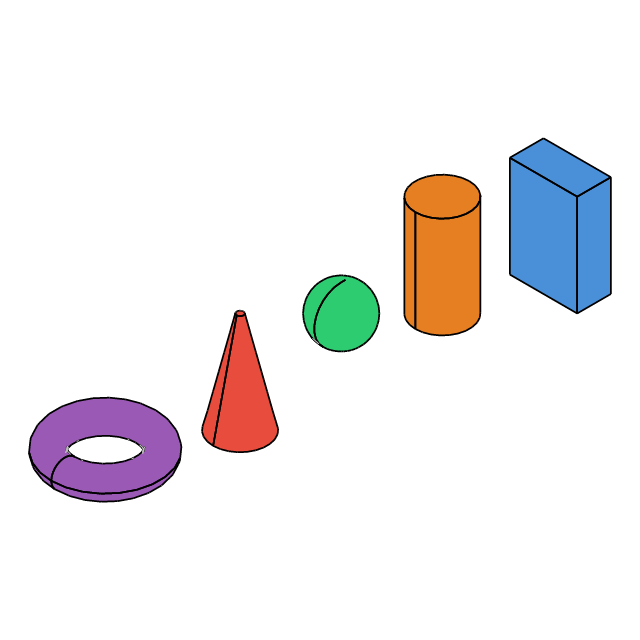
Primitive solids: box, cylinder, sphere, cone, torus — colored and exported as STEP + SVG.
//! Primitive solids: box, cylinder, sphere, cone, torus — colored and exported as STEP + SVG.

use cadrum::{DVec3, Solid};

fn main() -> Result<(), cadrum::Error> {
	let example_name = std::path::Path::new(file!()).file_stem().unwrap().to_str().unwrap();

	let solids = [Solid::cube(DVec3::ZERO, DVec3::new(10.0, 20.0, 30.0)).color("#4a90d9"), Solid::cylinder(8.0, DVec3::Z * 30.0).translate(DVec3::X * 30.0).color("#e67e22"), Solid::sphere(8.0).translate(DVec3::X * 60.0 + DVec3::Z * 15.0).color("#2ecc71"), Solid::cone(8.0, 1.0, DVec3::Z * 30.0).translate(DVec3::X * 90.0).color("#e74c3c"), Solid::torus(12.0, 4.0, DVec3::Z).translate(DVec3::X * 130.0 + DVec3::Z * 15.0).color("#9b59b6")];

	Solid::write_step(&solids, &mut std::fs::File::create(format!("{example_name}.step")).unwrap())?;

	let mesh = Solid::mesh(&solids, Default::default())?;
	let scene = mesh.scene(Default::default());
	scene.write_svg(&mut std::fs::File::create(format!("{example_name}.svg")).unwrap())?;
	scene.write_png([640, 640], &mut std::fs::File::create(format!("{example_name}.png")).unwrap())?;
	mesh.write_stl(&mut std::fs::File::create(format!("{example_name}.stl")).unwrap())?;
	mesh.write_gltf_binary(&mut std::fs::File::create(format!("{example_name}.glb")).unwrap())?;

	println!("wrote {example_name}.step / {example_name}.svg / {example_name}.png");
	Ok(())
}
Output: 01_primitives.png | 01_primitives.step | 01_primitives.glb | 01_primitives.stl | 01_primitives.svg
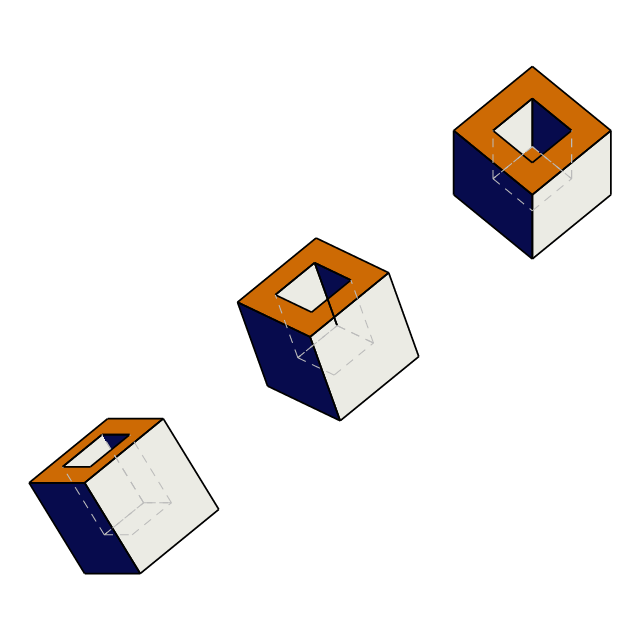
Write read
Read and write: chain STEP and BRep round-trips with progressive rotation.
//! Read and write: chain STEP and BRep round-trips with progressive rotation.

use cadrum::{DVec3, Solid};
use std::f64::consts::FRAC_PI_8;

fn main() -> Result<(), cadrum::Error> {
	let example_name = std::path::Path::new(file!()).file_stem().unwrap().to_str().unwrap();
	let step_path = format!("{example_name}.step");
	let brep_path = format!("{example_name}.brep");

	// 0. Original: read colored_box.step
	let manifest_dir = env!("CARGO_MANIFEST_DIR");
	let original = Solid::read_step(&mut std::fs::File::open(format!("{manifest_dir}/steps/colored_box.step")).expect("open file"))?;

	// 1. STEP round-trip: rotate 30° → write → read
	let a_written: Vec<Solid> = original.clone().into_iter().map(|s| s.rotate_x(FRAC_PI_8)).collect();
	Solid::write_step(&a_written, &mut std::fs::File::create(&step_path).expect("create file"))?;
	let a = Solid::read_step(&mut std::fs::File::open(&step_path).expect("open file"))?;

	// 2. BRep round-trip: rotate another 30° → write → read
	let b_written: Vec<Solid> = a.clone().into_iter().map(|s| s.rotate_x(FRAC_PI_8)).collect();
	Solid::write_brep(&b_written, &mut std::fs::File::create(&brep_path).expect("create file"))?;
	let b = Solid::read_brep(&mut std::fs::File::open(&brep_path).expect("open file"))?;

	// 3. Arrange side by side and export SVG + STL
	let [min, max] = original[0].bounding_box();
	let spacing = (max - min).length() * 1.5;
	let all: Vec<Solid> = [original, a, b].into_iter().enumerate().flat_map(|(i, solids)| solids.into_iter().map(move |s| s.translate(DVec3::X * spacing * i as f64))).collect();

	let mesh = Solid::mesh(&all, Default::default())?;
	let scene = mesh.scene(cadrum::SceneOption { view: DVec3::new(1.0, 1.0, 2.0), ..Default::default() });
	scene.write_svg(&mut std::fs::File::create(format!("{example_name}.svg")).unwrap())?;
	scene.write_png([640, 640], &mut std::fs::File::create(format!("{example_name}.png")).unwrap())?;

	mesh.write_stl(&mut std::fs::File::create(format!("{example_name}.stl")).unwrap())?;
	mesh.write_gltf_binary(&mut std::fs::File::create(format!("{example_name}.glb")).unwrap())?;

	// 4. Print summary
	let stl_path = format!("{example_name}.stl");
	for (label, path) in [("STEP", &step_path), ("BRep", &brep_path), ("STL", &stl_path)] {
		let size = std::fs::metadata(path).map(|m| m.len()).unwrap_or(0);
		println!("{label:12} {path:30} {size:>8} bytes");
	}

	Ok(())
}
Output: 02_write_read.png | 02_write_read.step | 02_write_read.glb | 02_write_read.brep | 02_write_read.stl | 02_write_read.svg
Transform
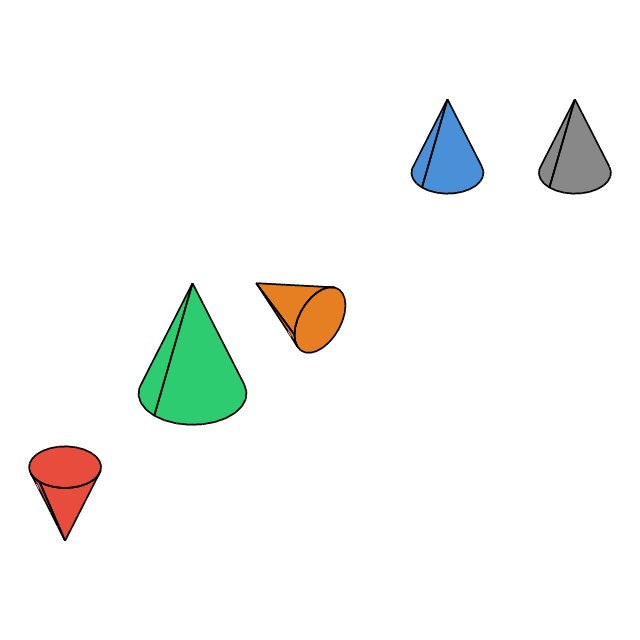
Transform operations: translate, rotate, scale, and mirror applied to a cone.
//! Transform operations: translate, rotate, scale, and mirror applied to a cone.

use cadrum::{DVec3, Solid};
use std::f64::consts::PI;

fn main() -> Result<(), cadrum::Error> {
	let example_name = std::path::Path::new(file!()).file_stem().unwrap().to_str().unwrap();

	let base = Solid::cone(8.0, 0.0, DVec3::Z * 20.0).color("#888888");

	let solids = [
		// original — reference, no transform
		base.clone(),
		// translate — shift +20 along Z
		base.clone().color("#4a90d9").translate(DVec3::X * 40.0 + DVec3::Z * 20.0),
		// rotate — 90° around X axis so the cone tips toward Y
		base.clone().color("#e67e22").rotate_x(PI / 2.0).translate(DVec3::X * 80.0),
		// scaled — 1.5x from its local origin
		base.clone().color("#2ecc71").scale(DVec3::ZERO, 1.5).translate(DVec3::X * 120.0),
		// mirror — flip across Z=0 plane so the tip points down
		base.clone().color("#e74c3c").mirror(DVec3::ZERO, DVec3::Z).translate(DVec3::X * 160.0),
	];

	Solid::write_step(&solids, &mut std::fs::File::create(format!("{example_name}.step")).unwrap())?;

	let mesh = Solid::mesh(&solids, Default::default())?;
	let scene = mesh.scene(Default::default());
	scene.write_svg(&mut std::fs::File::create(format!("{example_name}.svg")).unwrap())?;
	scene.write_png([640, 640], &mut std::fs::File::create(format!("{example_name}.png")).unwrap())?;
	mesh.write_stl(&mut std::fs::File::create(format!("{example_name}.stl")).unwrap())?;
	mesh.write_gltf_binary(&mut std::fs::File::create(format!("{example_name}.glb")).unwrap())?;

	println!("wrote {example_name}.step / {example_name}.svg / {example_name}.png");
	Ok(())
}
Output: 03_transform.png | 03_transform.step | 03_transform.glb | 03_transform.stl | 03_transform.svg
Boolean
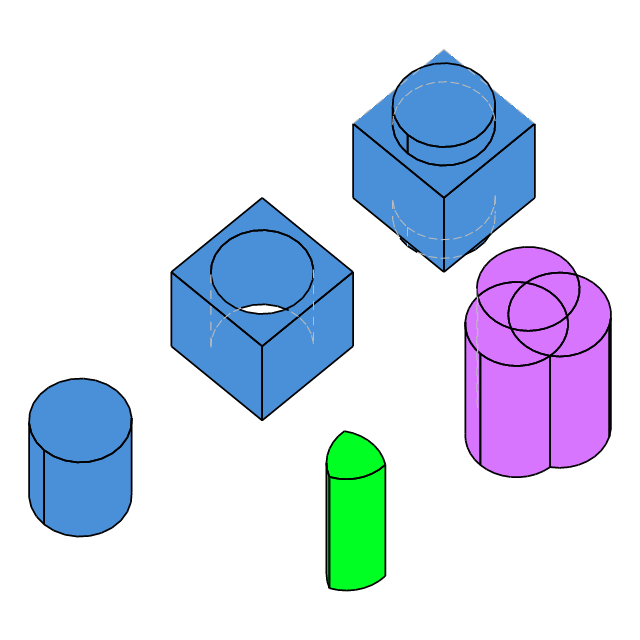
Boolean operations: union, subtract, and intersect between a box and a cylinder.
//! Boolean operations: union, subtract, and intersect between a box and a cylinder.

use cadrum::{Boolean, DVec3, Solid};

fn main() -> Result<(), cadrum::Error> {
	let example_name = std::path::Path::new(file!()).file_stem().unwrap().to_str().unwrap();

	let make_box = Solid::cube(DVec3::ZERO, DVec3::splat(20.0)).translate(DVec3::X * -10. + DVec3::Y * -10.).color("#4a90d9");
	let make_cyl = Solid::cylinder(8.0, DVec3::Z * 30.0).translate(DVec3::Z * -5.);

	// union: merge both shapes into one — offset X=0
	let union: Solid = (&make_box + &make_cyl).build()?;

	// subtract: box minus cylinder — offset X=40
	let subtract: Solid = (&make_box - &make_cyl).build()?;

	// intersect: only the overlapping volume — offset X=80
	let intersect: Solid = (&make_box * &make_cyl).build()?;

	let cylinder = Solid::cylinder(8.0, DVec3::Z * 30.0).translate(DVec3::X * 5.);
	let [cylinder0, cylinder1, cylinder2] = [cylinder.clone(), cylinder.clone().rotate_z(std::f64::consts::TAU / 3.), cylinder.clone().rotate_z(-std::f64::consts::TAU / 3.)];

	// union of all cylinders (fold from Boolean::default() = ⊥)
	let sum: Solid = [&cylinder0, &cylinder1, &cylinder2].into_iter().map(Boolean::from).reduce(|a, s| a + s).unwrap().build()?.clean()?;
	let sum = sum.color("#d875ff");

	// intersection of all cylinders (reduce — intersect has no fixed init)
	let product: Solid = [&cylinder0, &cylinder1, &cylinder2].into_iter().map(Boolean::from).reduce(|a, b| a * b).unwrap().build()?;
	let product = product.color("#00ff22");

	let shapes = [union.translate(DVec3::X * 0.0), subtract.translate(DVec3::X * 40.0), intersect.translate(DVec3::X * 80.0), sum.translate(DVec3::X * 20.0 + DVec3::Y * 40.0), product.translate(DVec3::X * 60.0 + DVec3::Y * 40.0)];

	Solid::write_step(&shapes, &mut std::fs::File::create(format!("{example_name}.step")).unwrap())?;

	let mesh = Solid::mesh(&shapes, Default::default())?;
	let scene = mesh.scene(cadrum::SceneOption { view: DVec3::new(1.0, 1.0, 2.0), ..Default::default() });
	scene.write_svg(&mut std::fs::File::create(format!("{example_name}.svg")).unwrap())?;
	scene.write_png([640, 640], &mut std::fs::File::create(format!("{example_name}.png")).unwrap())?;
	mesh.write_stl(&mut std::fs::File::create(format!("{example_name}.stl")).unwrap())?;
	mesh.write_gltf_binary(&mut std::fs::File::create(format!("{example_name}.glb")).unwrap())?;

	println!("wrote {example_name}.step / {example_name}.svg / {example_name}.png");
	Ok(())
}
Output: 04_boolean.png | 04_boolean.step | 04_boolean.glb | 04_boolean.stl | 04_boolean.svg
Extrude
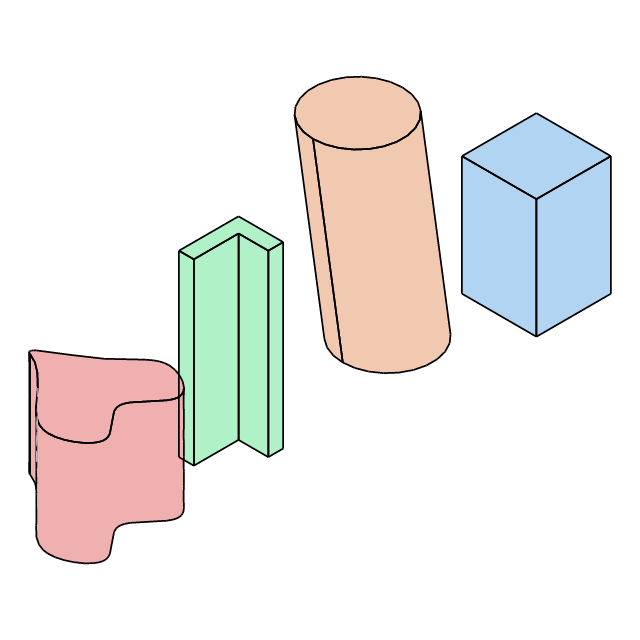
Demo of Solid::extrude: push a closed 2D profile along a direction vector.
//! Demo of `Solid::extrude`: push a closed 2D profile along a direction vector.

use cadrum::{BSplineEnd, DVec3, Edge, Error, Solid};

/// Circle extruded at a steep angle → oblique cylinder.
fn build_oblique_cylinder() -> Result<Solid, Error> {
	let profile = [Edge::circle(3.0, DVec3::Z)?];
	Solid::extrude(&profile, DVec3::new(-4.0, -6.0, 8.0))
}

/// L-shaped polygon → L-beam.
fn build_l_beam() -> Result<Solid, Error> {
	let profile = Edge::polygon(&[DVec3::new(0.0, 0.0, 0.0), DVec3::new(4.0, 0.0, 0.0), DVec3::new(4.0, 1.0, 0.0), DVec3::new(1.0, 1.0, 0.0), DVec3::new(1.0, 3.0, 0.0), DVec3::new(0.0, 3.0, 0.0)])?;
	Solid::extrude(&profile, DVec3::Z * 12.0)
}

/// Square plate with a round bore: `Edge::loops` splits the profile, the first
/// loop bounds the solid and the second becomes the hole.
fn build_plate_with_bore() -> Result<Solid, Error> {
	let outer = Edge::polygon(&[DVec3::new(-4.0, -3.0, 0.0), DVec3::new(4.0, -3.0, 0.0), DVec3::new(4.0, 3.0, 0.0), DVec3::new(-4.0, 3.0, 0.0)])?;
	let bore = Edge::circle(1.5, DVec3::Z)?;
	Solid::extrude(&[outer, vec![bore]].concat(), DVec3::Z * 2.0)
}

/// Heart-shaped BSpline profile extruded along Z.
fn build_heart() -> Result<Solid, Error> {
	let profile = [Edge::bspline(
		&[
			DVec3::new(0.0, -4.0, 0.0), // bottom tip
			DVec3::new(2.0, -1.5, 0.0),
			DVec3::new(4.0, 1.5, 0.0),
			DVec3::new(2.5, 3.5, 0.0),  // right lobe top
			DVec3::new(0.0, 2.0, 0.0),  // center dip
			DVec3::new(-2.5, 3.5, 0.0), // left lobe top
			DVec3::new(-4.0, 1.5, 0.0),
			DVec3::new(-2.0, -1.5, 0.0),
		],
		BSplineEnd::Periodic,
	)?];
	Solid::extrude(&profile, DVec3::Z * 7.0)
}

fn main() -> Result<(), Error> {
	let example_name = std::path::Path::new(file!()).file_stem().unwrap().to_str().unwrap();
	let result = [build_oblique_cylinder()?.color("#f1c8b0").translate(DVec3::X * 10.0), build_l_beam()?.color("#b0f1c8").translate(DVec3::X * 20.0), build_heart()?.color("#f1b0b0").translate(DVec3::X * 30.0), build_plate_with_bore()?.color("#d4b0f1").translate(DVec3::X * 40.0)];

	Solid::write_step(&result, &mut std::fs::File::create(format!("{example_name}.step")).unwrap())?;

	let mesh = Solid::mesh(&result, Default::default())?;
	let scene = mesh.scene(Default::default());
	scene.write_svg(&mut std::fs::File::create(format!("{example_name}.svg")).unwrap())?;
	scene.write_png([640, 640], &mut std::fs::File::create(format!("{example_name}.png")).unwrap())?;
	mesh.write_stl(&mut std::fs::File::create(format!("{example_name}.stl")).unwrap())?;
	mesh.write_gltf_binary(&mut std::fs::File::create(format!("{example_name}.glb")).unwrap())?;

	println!("wrote {example_name}.step / {example_name}.svg / {example_name}.png");
	Ok(())
}
Output: 05_extrude.png | 05_extrude.step | 05_extrude.glb | 05_extrude.stl | 05_extrude.svg

Revolve
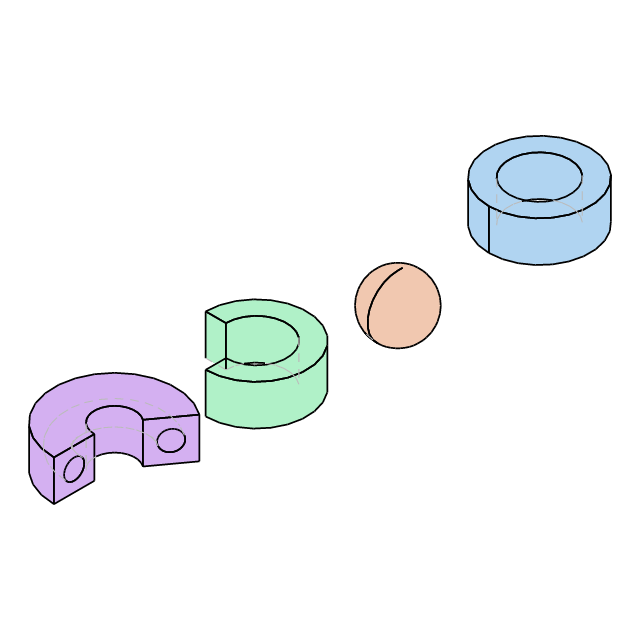
Demo of Solid::revolve: sweep a closed profile about an axis.
//! Demo of `Solid::revolve`: sweep a closed profile about an axis.
//!
//! - **Pipe**: rectangle in the XZ plane turned a full circle about Z
//! - **Sphere**: half disc turned about its own diameter — a profile may touch the axis
//! - **Partial**: the same rectangle turned three quarters of the way, showing the angle
//! - **Channel**: rectangle with a circular hole → ring with a hidden toroidal channel

use cadrum::{DVec3, Edge, Error, Solid};
use std::f64::consts::TAU;

/// Rectangle `x ∈ [x0, x1]`, `z ∈ [z0, z1]` in the XZ plane, the plane that contains the Z axis.
fn rect(x0: f64, x1: f64, z0: f64, z1: f64) -> Result<Vec<Edge>, Error> {
	Edge::polygon(&[DVec3::new(x0, 0.0, z0), DVec3::new(x1, 0.0, z0), DVec3::new(x1, 0.0, z1), DVec3::new(x0, 0.0, z1)])
}

/// Full turn → pipe (simplest revolve).
fn build_pipe() -> Result<Solid, Error> {
	Solid::revolve(&rect(3.0, 5.0, 0.0, 4.0)?, DVec3::ZERO, DVec3::Z, TAU)
}

/// Half disc about its diameter → sphere. The straight edge lies on the axis.
fn build_sphere() -> Result<Solid, Error> {
	let r = 3.0;
	let profile = [Edge::arc_3pts(DVec3::new(0.0, 0.0, -r), DVec3::new(r, 0.0, 0.0), DVec3::new(0.0, 0.0, r))?, Edge::line(DVec3::new(0.0, 0.0, r), DVec3::new(0.0, 0.0, -r))?];
	Solid::revolve(&profile, DVec3::ZERO, DVec3::Z, TAU)
}

/// Three quarters of a turn → open ring segment.
fn build_partial() -> Result<Solid, Error> {
	Solid::revolve(&rect(3.0, 5.0, 0.0, 4.0)?, DVec3::ZERO, DVec3::Z, TAU * 0.75)
}

/// Rectangle with a circular hole: the hole sweeps into a toroidal channel inside the ring.
fn build_channel() -> Result<Solid, Error> {
	let hole = Edge::circle(1.0, DVec3::Y)?.translate(DVec3::new(4.0, 0.0, 2.0));
	Solid::revolve(&[rect(2.0, 6.0, 0.0, 4.0)?, vec![hole]].concat(), DVec3::ZERO, DVec3::Z, -TAU * 0.6)
}

fn main() -> Result<(), Error> {
	let example_name = std::path::Path::new(file!()).file_stem().unwrap().to_str().unwrap();
	let result = [build_pipe()?.color("#b0d4f1"), build_sphere()?.color("#f1c8b0").translate(DVec3::X * 14.0), build_partial()?.color("#b0f1c8").translate(DVec3::X * 28.0), build_channel()?.color("#d4b0f1").translate(DVec3::X * 42.0)];
	Solid::write_step(&result, &mut std::fs::File::create(format!("{example_name}.step")).unwrap())?;
	let mesh = Solid::mesh(&result, Default::default())?;
	let scene = mesh.scene(Default::default());
	scene.write_svg(&mut std::fs::File::create(format!("{example_name}.svg")).unwrap())?;
	scene.write_png([640, 640], &mut std::fs::File::create(format!("{example_name}.png")).unwrap())?;
	mesh.write_stl(&mut std::fs::File::create(format!("{example_name}.stl")).unwrap())?;
	mesh.write_gltf_binary(&mut std::fs::File::create(format!("{example_name}.glb")).unwrap())?;
	println!("wrote {example_name}.step / {example_name}.svg / {example_name}.png");
	Ok(())
}
Output: 06_revolve.png | 06_revolve.step | 06_revolve.glb | 06_revolve.stl | 06_revolve.svg

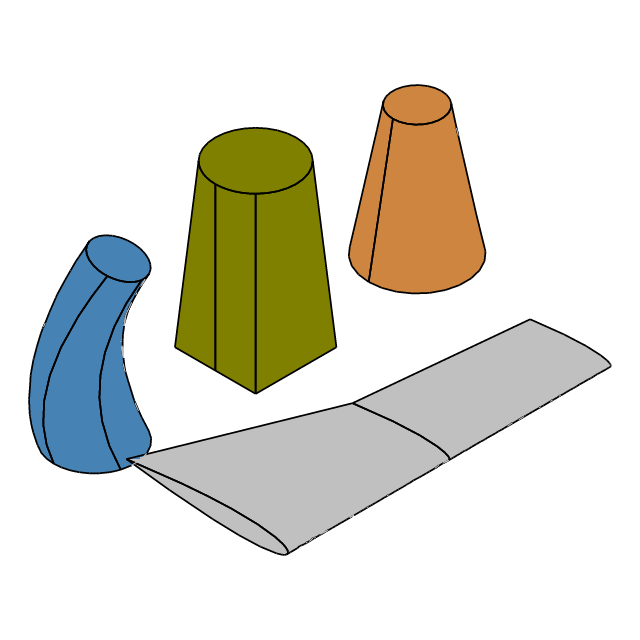
Loft
Demo of Solid::loft: skin a solid through cross-section wires.
//! Demo of `Solid::loft`: skin a solid through cross-section wires. //! //! - **Frustum**: two circles of different radii → truncated cone (minimal loft) //! - **Morph**: square polygon → circle (cross-section shape transition) //! - **Tilted**: three non-parallel circular sections → twisted loft //! - **Wing**: three NACA0012 sections lofted with `ruled=true` (straight ruled panels between sections — the sheet-metal / developable variant) use cadrum::{BSplineEnd, DVec2, DVec3, Edge, Error, Solid}; /// Two circles → frustum (minimal loft example). fn build_frustum() -> Result<Solid, Error> { let lower = [Edge::circle(3.0, DVec3::Z)?]; let upper = [Edge::circle(1.5, DVec3::Z)?.translate(DVec3::Z * 8.0)]; Ok(Solid::loft(&[lower, upper], false)?.color("#cd853f")) } /// Square polygon → circle (2-section morph loft). fn build_morph() -> Result<Solid, Error> { let r = 2.5; let square = Edge::polygon(&[DVec3::new(-r, -r, 0.0), DVec3::new(r, -r, 0.0), DVec3::new(r, r, 0.0), DVec3::new(-r, r, 0.0)])?; let circle = Edge::circle(r, DVec3::Z)?.translate(DVec3::Z * 10.0); Ok(Solid::loft([square.as_slice(), std::slice::from_ref(&circle)], false)?.color("#808000")) } /// Three non-parallel circular sections → twisted loft. fn build_tilted() -> Result<Solid, Error> { let bottom = [Edge::circle(2.5, DVec3::Z)?]; let mid = [Edge::circle(2.0, DVec3::new(0.3, 0.0, 1.0).normalize())?.translate(DVec3::X + DVec3::Z * 5.0)]; let top = [Edge::circle(1.5, DVec3::new(-0.2, 0.3, 1.0).normalize())?.translate(DVec3::new(-0.5, 1.0, 10.0))]; Ok(Solid::loft(&[bottom, mid, top], false)?.color("#4682b4")) } /// NACA0012-like airfoil section points (unit chord, 2D: x = chord, y = thickness). /// Cosine spacing walks TE → upper → LE → lower → TE, returning a closed loop /// with the TE point duplicated at the end (a closed section with a sharp TE, /// interpolated as a NotAKnot open curve). fn naca_points(n: usize) -> Vec<DVec2> { let half = |x: f64| 5.0 * 0.12 * (0.2969 * x.sqrt() - 0.1260 * x - 0.3516 * x * x + 0.2843 * x.powi(3) - 0.1036 * x.powi(4)); let upper: Vec<DVec2> = (0..=n) .map(|i| { let x = (1.0 + (std::f64::consts::PI * i as f64 / n as f64).cos()) / 2.0; DVec2::new(x, half(x)) }) .collect(); let lower: Vec<DVec2> = (1..=n) .map(|i| { let x = (1.0 - (std::f64::consts::PI * i as f64 / n as f64).cos()) / 2.0; DVec2::new(x, -half(x)) }) .collect(); [upper, lower].concat() } /// Three NACA sections → tapered wing, lofted with `ruled=true` (straight panels). fn build_wing(scale: f64) -> Result<Solid, Error> { let stations = [(1.0, 0.0), (0.6, 1.0), (0.5, 2.0)]; let sections: Vec<[Edge; 1]> = stations .iter() .map(|&(c, z)| { let points: Vec<DVec3> = naca_points(60).into_iter().map(|p| DVec3::new(c * p.x, c * p.y, z) * scale).collect(); [Edge::bspline(&points, BSplineEnd::NotAKnot).expect("NACA bspline section")] }) .collect(); Ok(Solid::loft(§ions, true)?.color("silver")) } fn main() -> Result<(), Error> { let example_name = std::path::Path::new(file!()).file_stem().unwrap().to_str().unwrap(); let frustum = build_frustum()?; let morph = build_morph()?.translate(DVec3::X * 10.0); let tilted = build_tilted()?.translate(DVec3::X * 20.0); let wing = build_wing(10.0)?.align_z(-DVec3::X, -DVec3::Y).translate(DVec3::X * 20.0 + DVec3::Y * 12.0); let result = [frustum, morph, tilted, wing]; Solid::write_step(&result, &mut std::fs::File::create(format!("{example_name}.step")).unwrap())?; let mesh = Solid::mesh(&result, Default::default())?; let scene = mesh.scene(Default::default()); scene.write_svg(&mut std::fs::File::create(format!("{example_name}.svg")).unwrap())?; scene.write_png([640, 640], &mut std::fs::File::create(format!("{example_name}.png")).unwrap())?; mesh.write_stl(&mut std::fs::File::create(format!("{example_name}.stl")).unwrap())?; mesh.write_gltf_binary(&mut std::fs::File::create(format!("{example_name}.glb")).unwrap())?; println!("wrote {example_name}.step / {example_name}.svg / {example_name}.png"); Ok(()) }
Output: 07_loft.png | 07_loft.step | 07_loft.glb | 07_loft.stl | 07_loft.svg

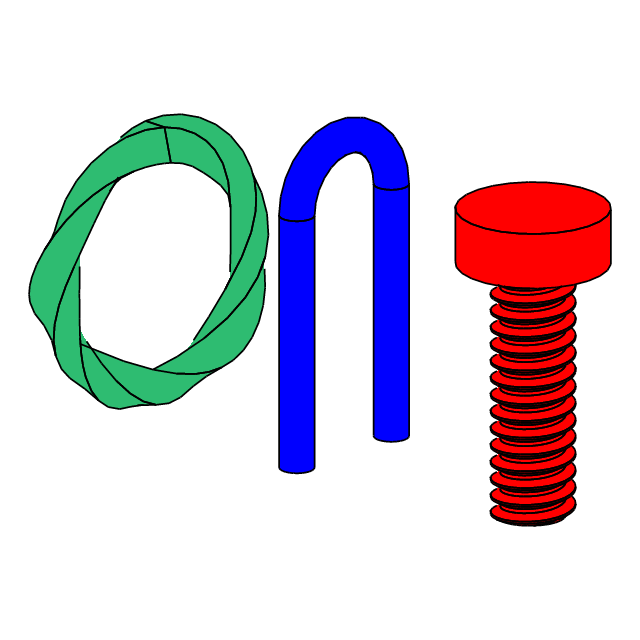
Sweep
Sweep showcase: M2 screw (helix spine) + U-shaped pipe (line+arc+line spine)
//! Sweep showcase: M2 screw (helix spine) + U-shaped pipe (line+arc+line spine)
//!
//! `ProfileOrient` controls how the profile is oriented as it travels along the spine:
//!
//! - `Fixed`: profile is parallel-transported without rotating. Cross-sections
//!   stay parallel to the starting orientation. Suited for straight extrusions;
//!   on a curved spine the profile drifts off the tangent and the result breaks.
//! - `Torsion`: profile follows the spine's principal normal (raw Frenet–Serret
//!   frame). Suited for constant-curvature/torsion curves like helices and for
//!   3D free curves where the natural twist should carry into the profile.
//!   Fails near inflection points where the principal normal flips.
//! - `Up(axis)`: profile keeps `axis` as its binormal — at every point the
//!   profile is rotated around the tangent so one in-plane axis stays in the
//!   tangent–`axis` plane. Suited for roads/rails/pipes that must preserve a
//!   gravity direction. On a helix, `Up(helix_axis)` is equivalent to `Torsion`.
//!   Fails when the tangent becomes parallel to `axis`.
//! - `Auxiliary(aux_spine)`: profile's tracked axis points from the main spine
//!   toward a parallel auxiliary spine. Arbitrary twist control — e.g. a
//!   helical `aux_spine` on a straight `spine` produces a twisted ribbon.

use cadrum::{BSplineEnd, DQuat, DVec3, Edge, Error, ProfileOrient, Solid};

// ==================== Component 1: M2 ISO screw ====================

fn build_m2_screw() -> Result<Solid, Error> {
	let r = 1.0;
	let h_pitch = 0.4;
	let h_thread = 6.0;
	let r_head = 1.75;
	let h_head = 1.3;
	// ISO M thread fundamental triangle height: H = √3/2 · P (sharp 60° triangle).
	let r_delta = 3f64.sqrt() / 2.0 * h_pitch;

	// Helix spine at the root radius. x_ref=+X anchors the start at (r-r_delta, 0, 0).
	let helix = Edge::helix(r - r_delta, h_pitch, h_thread, DVec3::Z, DVec3::X)?;

	// Closed triangular profile in local coords (x: radial, y: along helix tangent).
	let profile = Edge::polygon(&[DVec3::new(0.0, -h_pitch / 2.0, 0.0), DVec3::new(r_delta, 0.0, 0.0), DVec3::new(0.0, h_pitch / 2.0, 0.0)])?;

	// Align profile +Z with the helix start tangent, then translate to the start point.
	let profile: Vec<Edge> = profile.into_iter().map(|e| e.align_z(helix.start_tangent(), helix.start_point()).translate(helix.start_point())).collect();

	// Sweep along the helix. Up(+Z) ≡ Torsion for a helix and yields a correct thread.
	let thread = Solid::sweep(&profile, &[helix], ProfileOrient::Up(DVec3::Z))?;

	// Reconstruct the ISO 68-1 basic profile (trapezoid) from the sharp triangle:
	//   union(shaft) fills the bottom H/4 → P/4-wide flat at the root
	//   intersect(crest) trims the top H/8 → P/8-wide flat at the crest
	let shaft = Solid::cylinder(r - r_delta * 6.0 / 8.0, DVec3::Z * h_thread);
	let crest = Solid::cylinder(r - r_delta / 8.0, DVec3::Z * h_thread);
	let thread_shaft: Solid = ((&thread + &shaft) * &crest).build()?;

	// Stack the flat head on top. Screw ends up centered on the origin.
	let head = Solid::cylinder(r_head, DVec3::Z * h_head).translate(DVec3::Z * h_thread);
	let res: Solid = (&thread_shaft + &head).build()?;
	Ok(res.color("red"))
}

// ==================== Component 2: U-shaped pipe ====================

fn build_u_pipe() -> Result<Solid, Error> {
	let pipe_radius = 0.4;
	let leg_length = 6.0;
	let gap = 3.0;
	let half_gap = gap / 2.0;
	let bend_radius = half_gap;

	// U-shaped path in the XZ plane, centered on origin in X: A↑B ⌒ C↓D.
	let a = DVec3::new(0.0, -half_gap, 0.0);
	let b = DVec3::new(0.0, -half_gap, leg_length);
	let arc_mid = DVec3::new(0.0, 0.0, leg_length + bend_radius);
	let c = DVec3::new(0.0, half_gap, leg_length);
	let d = DVec3::new(0.0, half_gap, 0.0);

	// Spine wire: line → semicircle → line.
	let up_leg = Edge::line(a, b)?;
	let bend = Edge::arc_3pts(b, arc_mid, c)?;
	let down_leg = Edge::line(c, d)?;

	// Circular profile in XY (normal +Z) translated to the spine start `a`.
	// Spine tangent at `a` is +Z, so the XY-plane circle is already aligned.
	let profile = Edge::circle(pipe_radius, DVec3::Z)?.translate(a);

	// Up(+Y) fixes the binormal to the path-plane normal, avoiding Frenet
	// degeneracy on the straight segments.
	let pipe = Solid::sweep(&[profile], &[up_leg, bend, down_leg], ProfileOrient::Torsion)?;
	Ok(pipe.translate(DVec3::X * 6.0).color("blue"))
}

fn build_moebius(r: f64) -> Result<Solid, Error> {
	const N: usize = 24;
	let phi = |phi: f64| -> [DVec3; 2] {
		let [p, d] = [DVec3::X * r, DVec3::X * r / 10.];
		let [rz, ry] = [DQuat::from_rotation_z(phi), DQuat::from_rotation_y(2. * phi)];
		[rz * p, rz * (p + ry * d)]
	};
	let ring: [[DVec3; 2]; N] = std::array::from_fn(|i| phi(i as f64 / N as f64 * std::f64::consts::TAU));
	let spine = Edge::bspline(&(ring.map(|v| v[0])), BSplineEnd::Periodic)?;
	let aux = Edge::bspline(&(ring.map(|v| v[1])), BSplineEnd::Periodic)?;
	let profile = Edge::polygon(&[DVec3::new(-0.3, -0.3, 0.0), DVec3::new(0.5, -0.5, 0.0), DVec3::new(0.3, 0.3, 0.0), DVec3::new(-0.3, 0.3, 0.0)])?;
	let profile: Vec<Edge> = profile.into_iter().map(|e| e.align_z(spine.start_tangent(), DVec3::Y).translate(spine.start_point())).collect();
	let band = Solid::sweep(&profile, &[spine], ProfileOrient::Auxiliary(&[aux]))?;
	Ok(band.align_z(DVec3::X, DVec3::Z).translate(DVec3::X * 12.0 + DVec3::Z * r).color("#2ebc71"))
}

fn main() -> Result<(), Error> {
	let example_name = std::path::Path::new(file!()).file_stem().unwrap().to_str().unwrap();
	let all = [build_m2_screw()?, build_u_pipe()?, build_moebius(3.)?];

	Solid::write_step(&all, &mut std::fs::File::create(format!("{example_name}.step")).unwrap())?;

	// Helical threads have dense hidden lines that clutter the output; disable them.
	let mesh = Solid::mesh(&all, Default::default())?;
	let scene = mesh.scene(cadrum::SceneOption { view: DVec3::new(-1.0, 1.0, 0.5), hidden_edges: false, ..Default::default() });
	scene.write_svg(&mut std::fs::File::create(format!("{example_name}.svg")).unwrap())?;
	scene.write_png([640, 640], &mut std::fs::File::create(format!("{example_name}.png")).unwrap())?;
	mesh.write_stl(&mut std::fs::File::create(format!("{example_name}.stl")).unwrap())?;
	mesh.write_gltf_binary(&mut std::fs::File::create(format!("{example_name}.glb")).unwrap())?;

	println!("wrote {example_name}.step / {example_name}.svg / {example_name}.png ({} solids)", all.len());
	Ok(())
}
Output: 08_sweep.png | 08_sweep.step | 08_sweep.glb | 08_sweep.stl | 08_sweep.svg

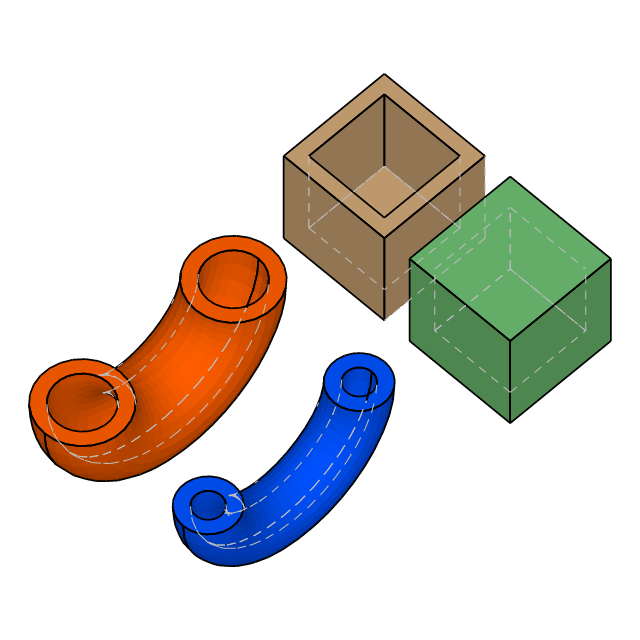
Shell
Demo of Solid::shell:
//! Demo of `Solid::shell`:
//! - Cube: remove top face, offset inward → open-top container
//! - Sealed cube: empty open_faces → solid with an internal void (outer skin
//!   + reversed inner shell)
//! - Torus: bisect with a half-space to introduce planar cut faces, then
//!   shell using those cut faces as the openings → thin-walled half-ring
//!   with both cross-sections exposed

use cadrum::{DVec3, Error, Solid};

fn hollow_cube() -> Result<Solid, Error> {
	let cube = Solid::cube(DVec3::ZERO, DVec3::splat(8.0));
	// TopExp_Explorer order on a box is stable; +Z face ends up last.
	let top = cube.iter_face().last().expect("cube has faces");
	cube.shell(-1.0, [top])
}

fn sealed_cube() -> Result<Solid, Error> {
	let cube = Solid::cube(DVec3::ZERO, DVec3::splat(8.0));
	cube.shell(-1.0, std::iter::empty::<&cadrum::Face>())
}

fn halved_shelled_torus(thickness: f64) -> Result<Solid, Error> {
	let torus = Solid::torus(6.0, 2.0, DVec3::Y);
	// Bisect with Y=0 half-space (normal +Y): keep the +Y half of the ring — always 1 solid.
	let cutter = Solid::half_space(DVec3::ZERO, -DVec3::Z);
	// `iter_history()` yields [post_id, src_id] pairs for every result face.
	// Filter to those whose src_id is one of the cutter's faces, then collect
	// their post_ids — these are the planar cut faces in the result that we
	// want to use as shell openings.
	let cutter_face_ids: std::collections::HashSet<u64> = cutter.iter_face().map(|f| f.id()).collect();
	let half: Solid = (&torus * &cutter).build()?;
	let from_cutter: std::collections::HashSet<u64> = half.iter_history().filter_map(|[post, src]| cutter_face_ids.contains(&src).then_some(post)).collect();
	half.shell(thickness, half.iter_face().filter(|f| from_cutter.contains(&f.id())))
}

fn main() -> Result<(), Error> {
	let example_name = std::path::Path::new(file!()).file_stem().unwrap().to_str().unwrap();

	let result = [hollow_cube()?.color("#d0a878"), sealed_cube()?.color("#6fbf73").translate(DVec3::Y * 10.0), halved_shelled_torus(1.0)?.color("#ff5e00").translate(DVec3::X * 18.0), halved_shelled_torus(-1.0)?.color("#0052ff").translate(DVec3::X * 18.0 + DVec3::Y * 10.0)];

	Solid::write_step(&result, &mut std::fs::File::create(format!("{example_name}.step")).unwrap())?;

	// Isometric view from (1, 1, 2) with shading so the cavity depth reads
	// naturally.
	let mesh = Solid::mesh(&result, Default::default())?;
	let scene = mesh.scene(cadrum::SceneOption { view: DVec3::new(1.0, 1.0, 2.0), shading: true, ..Default::default() });
	scene.write_svg(&mut std::fs::File::create(format!("{example_name}.svg")).unwrap())?;
	scene.write_png([640, 640], &mut std::fs::File::create(format!("{example_name}.png")).unwrap())?;
	mesh.write_stl(&mut std::fs::File::create(format!("{example_name}.stl")).unwrap())?;
	mesh.write_gltf_binary(&mut std::fs::File::create(format!("{example_name}.glb")).unwrap())?;

	println!("wrote {example_name}.step / {example_name}.svg / {example_name}.png");
	Ok(())
}
Output: 09_shell.png | 09_shell.step | 09_shell.glb | 09_shell.stl | 09_shell.svg

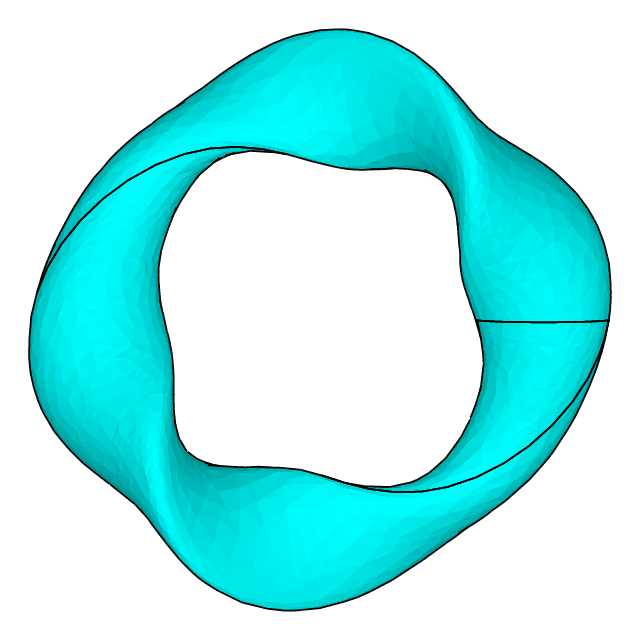
Bspline
// 2 field-period stellarator-like torus.
// `Solid::bspline` is fed a 2D control-point grid to build a periodic B-spline solid.
// Every variation below is invariant under phi → phi+π (or shifts by a multiple
// of 2π), so the resulting shape has 180° rotational symmetry around the Z axis:
//   a(phi)       = 1.8 + 0.6 * sin(2φ)      radial semi-axis
//   b(phi)       = 1.0 + 0.4 * cos(2φ)      Z semi-axis
//   psi(phi)     = 2 * phi                  cross-section twist (2 turns per loop)
//   z_shift(phi) = 1.0 * sin(2φ)            vertical undulation
use cadrum::{DQuat, DVec3, Solid};
use std::f64::consts::TAU;
const M: usize = 48; // toroidal (U) — must be even for 180° symmetry
const N: usize = 24; // poloidal (V) — arbitrary
const RING_R: f64 = 6.0;

fn point(i: usize, j: usize) -> DVec3 {
	let phi = TAU * (i as f64) / (M as f64);
	let theta = TAU * (j as f64) / (N as f64);
	let two_phi = 2.0 * phi;
	let a = 1.8 + 0.6 * two_phi.sin();
	let b = 1.0 + 0.4 * two_phi.cos();
	let psi = two_phi; // twist: 2 full turns per toroidal loop
	let z_shift = 1.0 * two_phi.sin();
	// 1. Local cross-section (pre-twist ellipse in the (X, Z) plane)
	let local_raw = DVec3::X * (a * theta.cos()) + DVec3::Z * (b * theta.sin());
	// 2. Rotate by psi around the local Y axis (major-circle tangent) — the twist
	let local_twisted = DQuat::from_axis_angle(DVec3::Y, psi) * local_raw;
	// 3. Undulate vertically in the local frame
	let local_shifted = local_twisted + DVec3::Z * z_shift;
	// 4. Push outward along the major radius by RING_R
	let translated = local_shifted + DVec3::X * RING_R;
	// 5. Rotate the whole point around the global Z axis by phi
	DQuat::from_axis_angle(DVec3::Z, phi) * translated
}

fn main() -> Result<(), cadrum::Error> {
	let example_name = std::path::Path::new(file!()).file_stem().unwrap().to_str().unwrap();

	let plasma = Solid::bspline(M, N, true, point).expect("2-period bspline torus should succeed");
	let objects = [plasma.color("cyan")];

	Solid::write_step(&objects, &mut std::fs::File::create(format!("{example_name}.step")).unwrap())?;

	let mesh = Solid::mesh(&objects, Default::default())?;
	let scene = mesh.scene(cadrum::SceneOption { view: DVec3::new(0.05, 0.05, 1.0), up: DVec3::Y, hidden_edges: false, shading: true });
	scene.write_svg(&mut std::fs::File::create(format!("{example_name}.svg")).unwrap())?;
	scene.write_png([640, 640], &mut std::fs::File::create(format!("{example_name}.png")).unwrap())?;
	mesh.write_stl(&mut std::fs::File::create(format!("{example_name}.stl")).unwrap())?;
	mesh.write_gltf_binary(&mut std::fs::File::create(format!("{example_name}.glb")).unwrap())?;

	println!("wrote {example_name}.step / {example_name}.svg / {example_name}.png");
	Ok(())
}
Output: 10_bspline.png | 10_bspline.step | 10_bspline.glb | 10_bspline.stl | 10_bspline.svg

Fillet
Demo of Solid::fillet_edges:
//! Demo of `Solid::fillet_edges`:
//! - All 12 cube edges filleted uniformly (rounded cube)
//! - Only top 4 edges filleted (soft top, sharp base)
//! - Cylinder top circular edge filleted (coin shape)

use cadrum::{DVec3, Error, Solid};

fn rounded_cube(size: f64) -> Result<Solid, Error> {
	let cube = Solid::cube(DVec3::ZERO, DVec3::splat(size)).translate(-DVec3::ONE * (size / 2.0));
	let radius = size * 0.2;
	cube.fillet_edges(radius, cube.iter_edge())
}

fn soft_top_cube(size: f64) -> Result<Solid, Error> {
	let cube = Solid::cube(DVec3::ZERO, DVec3::splat(size)).translate(-DVec3::ONE * (size / 2.0));
	let radius = size * 0.2;
	// Top cap boundary: a closed circular edge whose start == end lives at z = h.
	let top_edges = cube.iter_edge().filter(|e| [e.start_point(), e.end_point()].iter().all(|p| (p.z - size / 2.0).abs() < 1e-6));
	cube.fillet_edges(radius, top_edges)
}

fn coin(radius: f64, height: f64) -> Result<Solid, Error> {
	let cyl = Solid::cylinder(radius, DVec3::Z * height);
	let radius = height * 0.3;
	// Top cap boundary: a closed circular edge whose start == end lives at z = h.
	let top_circle = cyl.iter_edge().filter(|e| [e.start_point(), e.end_point()].iter().all(|p| (p.z - height).abs() < 1e-6));
	cyl.fillet_edges(radius, top_circle)
}

fn main() -> Result<(), Error> {
	let example_name = std::path::Path::new(file!()).file_stem().unwrap().to_str().unwrap();

	let result = [rounded_cube(8.0)?.color("#d0a878"), soft_top_cube(8.0)?.color("#6fbf73").translate(DVec3::X * 12.0), coin(4.0, 2.0)?.color("#0052ff").translate(DVec3::X * 24.0)];

	Solid::write_step(&result, &mut std::fs::File::create(format!("{example_name}.step")).unwrap())?;

	let mesh = Solid::mesh(&result, Default::default())?;
	let scene = mesh.scene(cadrum::SceneOption { view: DVec3::new(1.0, 1.0, 2.0), shading: true, ..Default::default() });
	scene.write_svg(&mut std::fs::File::create(format!("{example_name}.svg")).unwrap())?;
	scene.write_png([640, 640], &mut std::fs::File::create(format!("{example_name}.png")).unwrap())?;
	mesh.write_stl(&mut std::fs::File::create(format!("{example_name}.stl")).unwrap())?;
	mesh.write_gltf_binary(&mut std::fs::File::create(format!("{example_name}.glb")).unwrap())?;

	println!("wrote {example_name}.step / {example_name}.svg / {example_name}.png");
	Ok(())
}
Output: 11_fillet.png | 11_fillet.step | 11_fillet.glb | 11_fillet.stl | 11_fillet.svg
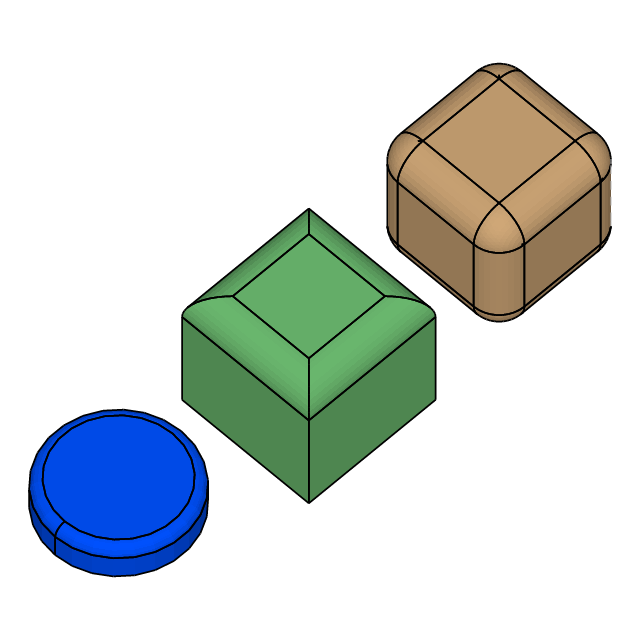

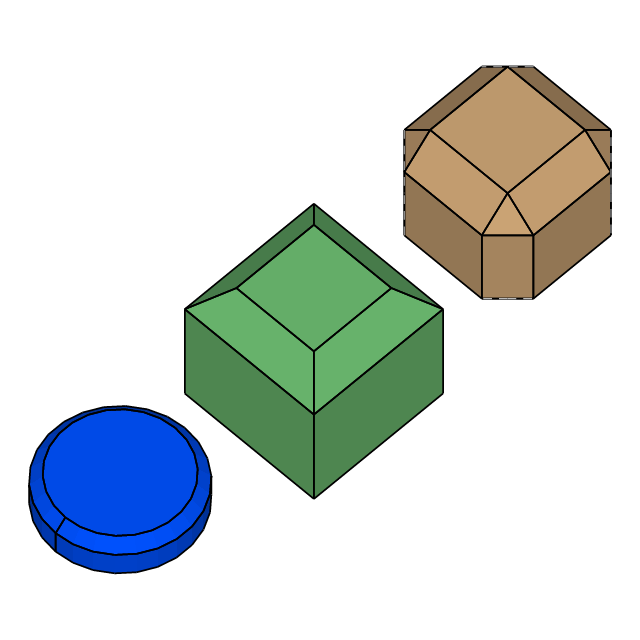
Chamfer
Demo of Solid::chamfer_edges — mirror of 11_fillet.rs using bevels:
//! Demo of `Solid::chamfer_edges` — mirror of `11_fillet.rs` using bevels:
//! - All 12 cube edges chamfered uniformly (beveled cube)
//! - Only top 4 edges chamfered (soft top, sharp base)
//! - Cylinder top circular edge chamfered (coin with beveled rim)

use cadrum::{DVec3, Error, Solid};

fn beveled_cube(size: f64) -> Result<Solid, Error> {
	let cube = Solid::cube(DVec3::ZERO, DVec3::splat(size)).translate(-DVec3::ONE * (size / 2.0));
	let distance = size * 0.2;
	cube.chamfer_edges(distance, cube.iter_edge())
}

fn beveled_top_cube(size: f64) -> Result<Solid, Error> {
	let cube = Solid::cube(DVec3::ZERO, DVec3::splat(size)).translate(-DVec3::ONE * (size / 2.0));
	let distance = size * 0.2;
	// Top cap boundary: a closed circular edge whose start == end lives at z = h.
	let top_edges = cube.iter_edge().filter(|e| [e.start_point(), e.end_point()].iter().all(|p| (p.z - size / 2.0).abs() < 1e-6));
	cube.chamfer_edges(distance, top_edges)
}

fn beveled_coin(radius: f64, height: f64) -> Result<Solid, Error> {
	let cyl = Solid::cylinder(radius, DVec3::Z * height);
	let distance = height * 0.3;
	// Top cap boundary: a closed circular edge whose start == end lives at z = h.
	let top_circle = cyl.iter_edge().filter(|e| [e.start_point(), e.end_point()].iter().all(|p| (p.z - height).abs() < 1e-6));
	cyl.chamfer_edges(distance, top_circle)
}

fn main() -> Result<(), Error> {
	let example_name = std::path::Path::new(file!()).file_stem().unwrap().to_str().unwrap();

	let result = [beveled_cube(8.0)?.color("#d0a878"), beveled_top_cube(8.0)?.color("#6fbf73").translate(DVec3::X * 12.0), beveled_coin(4.0, 2.0)?.color("#0052ff").translate(DVec3::X * 24.0)];

	Solid::write_step(&result, &mut std::fs::File::create(format!("{example_name}.step")).unwrap())?;

	let mesh = Solid::mesh(&result, Default::default())?;
	let scene = mesh.scene(cadrum::SceneOption { view: DVec3::new(1.0, 1.0, 2.0), shading: true, ..Default::default() });
	scene.write_svg(&mut std::fs::File::create(format!("{example_name}.svg")).unwrap())?;
	scene.write_png([640, 640], &mut std::fs::File::create(format!("{example_name}.png")).unwrap())?;
	mesh.write_stl(&mut std::fs::File::create(format!("{example_name}.stl")).unwrap())?;
	mesh.write_gltf_binary(&mut std::fs::File::create(format!("{example_name}.glb")).unwrap())?;

	println!("wrote {example_name}.step / {example_name}.svg / {example_name}.png");
	Ok(())
}
Output: 12_chamfer.png | 12_chamfer.step | 12_chamfer.glb | 12_chamfer.stl | 12_chamfer.svg

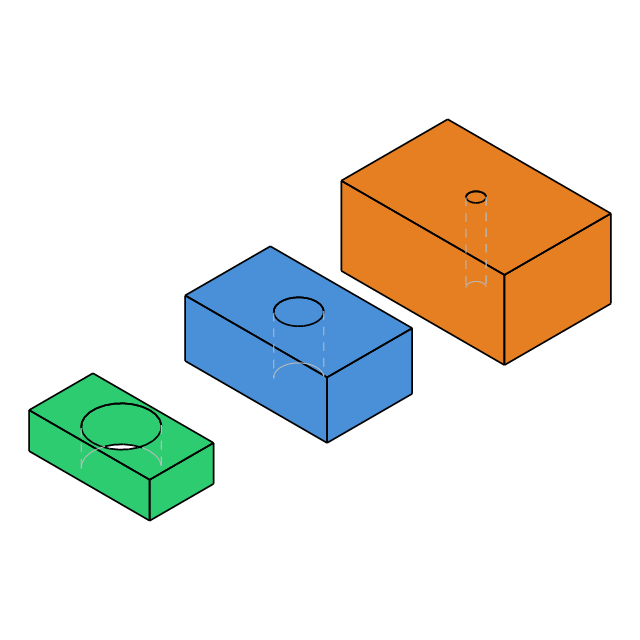
Offset
Signed surface offset: one drilled block grown by +3, the original, and shrunk by -3 side by side — every face moves along its normal, so the hole shrinks as the body grows.
//! Signed surface offset: one drilled block grown by +3, the original, and shrunk by -3 side by side — every face moves along its normal, so the hole shrinks as the body grows.

use cadrum::{DVec3, Solid};

fn main() -> Result<(), cadrum::Error> {
	let example_name = std::path::Path::new(file!()).file_stem().unwrap().to_str().unwrap();

	let block = Solid::cube(DVec3::ZERO, DVec3::new(24.0, 40.0, 16.0));
	let hole = Solid::cylinder(5.0, DVec3::Z * 16.0).translate(DVec3::new(12.0, 20.0, 0.0));
	let part = (&block - &hole).build()?.color("#4a90d9");

	// offset > 0 grows outward (hole tightens), offset < 0 shrinks inward (hole widens).
	let grown = part.offset(3.0, part.iter_face(), 1.0e-6)?.translate(-DVec3::X * 50.0).color("#e67e22");
	let shrunk = part.offset(-3.0, part.iter_face(), 1.0e-6)?.translate(DVec3::X * 50.0).color("#2ecc71");

	let solids = [grown, part, shrunk];
	Solid::write_step(&solids, &mut std::fs::File::create(format!("{example_name}.step")).unwrap())?;

	let mesh = Solid::mesh(&solids, Default::default())?;
	let scene = mesh.scene(Default::default());
	scene.write_svg(&mut std::fs::File::create(format!("{example_name}.svg")).unwrap())?;
	scene.write_png([640, 640], &mut std::fs::File::create(format!("{example_name}.png")).unwrap())?;
	mesh.write_stl(&mut std::fs::File::create(format!("{example_name}.stl")).unwrap())?;
	mesh.write_gltf_binary(&mut std::fs::File::create(format!("{example_name}.glb")).unwrap())?;

	println!("wrote {example_name}.step / {example_name}.svg / {example_name}.png");
	Ok(())
}
Output: 13_offset.png | 13_offset.step | 13_offset.glb | 13_offset.stl | 13_offset.svg
Sew
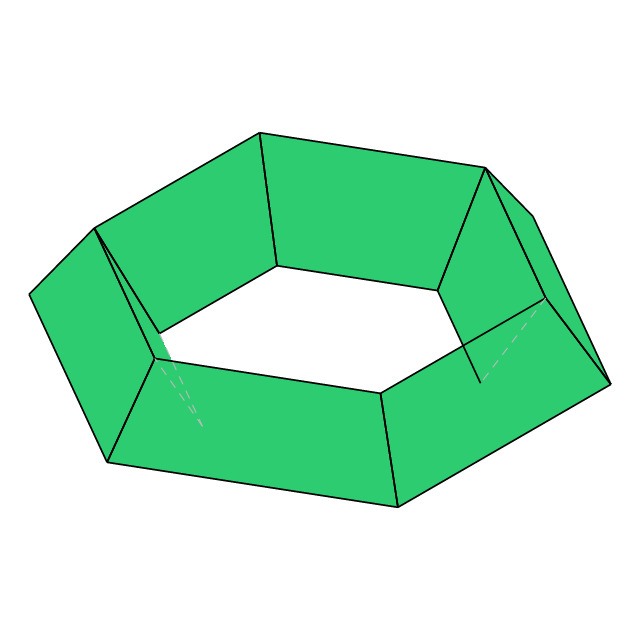
Sew closes a seam no boolean can: a hexagonal ring of mitered triangular prisms is lofted with coincident first/last sections, the caps are dropped, sew fuses the ring (genus 0 → 1), and clean erases the seam edges entirely.
//! Sew closes a seam no boolean can: a hexagonal ring of mitered triangular prisms is lofted with coincident first/last sections, the caps are dropped, sew fuses the ring (genus 0 → 1), and clean erases the seam edges entirely.
// sew (#186) targets surface-first work: closing lofted skin panels or surface-only STEP into a watertight solid.
// The seam sits mid-segment, so its two half-panels are coplanar and clean can dissolve the stitched edges.

use cadrum::{DVec3, Edge, Face, Solid};
use std::f64::consts::{PI, TAU};

fn main() -> Result<(), cadrum::Error> {
	let example_name = std::path::Path::new(file!()).file_stem().unwrap().to_str().unwrap();

	let (m, r) = (6usize, 20.0);
	let profile = [(-5.0, -4.0), (5.0, -2.0), (0.0, 6.0)]; // (radial, z), tilted so only the seam planes coincide
	let vert = |k: usize| DVec3::new((TAU * k as f64 / m as f64).cos(), (TAU * k as f64 / m as f64).sin(), 0.0) * r;

	// Miter section at ring vertex k: profile stretched by 1/cos(alpha) along the radial bisector.
	let alpha = PI / m as f64;
	let miter = |k: usize| profile.map(|(u, z)| vert(k) + vert(k).normalize() * (u / alpha.cos()) + DVec3::Z * z);
	// Perpendicular section at the middle of segment 0 — the seam, where the loft starts and ends.
	let mid_pt = (vert(0) + vert(1)) / 2.0;
	let mid = profile.map(|(u, z)| mid_pt + mid_pt.normalize() * u + DVec3::Z * z);

	let sections: Vec<Vec<Edge>> = std::iter::once(mid).chain((1..=m).map(miter)).chain(std::iter::once(mid)).map(|pts| Edge::polygon(&pts)).collect::<Result<_, _>>()?;
	let fake = Solid::loft(sections.iter(), true)?;

	let seam = mid_pt - DVec3::Z;
	let d0 = (vert(1) - vert(0)).normalize();
	let ring: Vec<&Face> = fake
		.iter_face()
		.filter(|f| {
			let (p, normal) = f.project(seam);
			!((p - seam).length() < 1e-6 && normal.dot(d0).abs() > 0.9)
		})
		.collect();
	let torus = Solid::sew(ring, 1.0e-6)?.clean()?.color("#2ecc71");
	println!("faces: fake={} torus={} / contains(seam): fake={} torus={}", fake.iter_face().count(), torus.iter_face().count(), fake.contains(seam), torus.contains(seam));

	let solids = [torus];
	Solid::write_step(&solids, &mut std::fs::File::create(format!("{example_name}.step")).unwrap())?;

	let mesh = Solid::mesh(&solids, Default::default())?;
	let scene = mesh.scene(Default::default());
	scene.write_svg(&mut std::fs::File::create(format!("{example_name}.svg")).unwrap())?;
	scene.write_png([640, 640], &mut std::fs::File::create(format!("{example_name}.png")).unwrap())?;
	mesh.write_stl(&mut std::fs::File::create(format!("{example_name}.stl")).unwrap())?;
	mesh.write_gltf_binary(&mut std::fs::File::create(format!("{example_name}.glb")).unwrap())?;

	println!("wrote {example_name}.step / {example_name}.svg / {example_name}.png");
	Ok(())
}
Output: 14_sew.png | 14_sew.step | 14_sew.glb | 14_sew.stl | 14_sew.svg

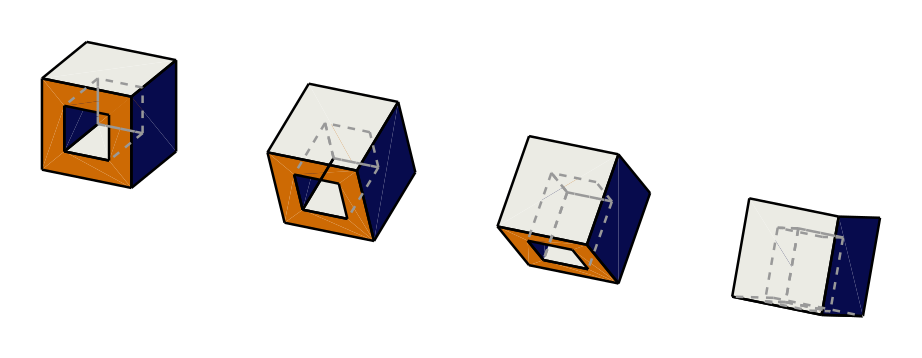
Multiview
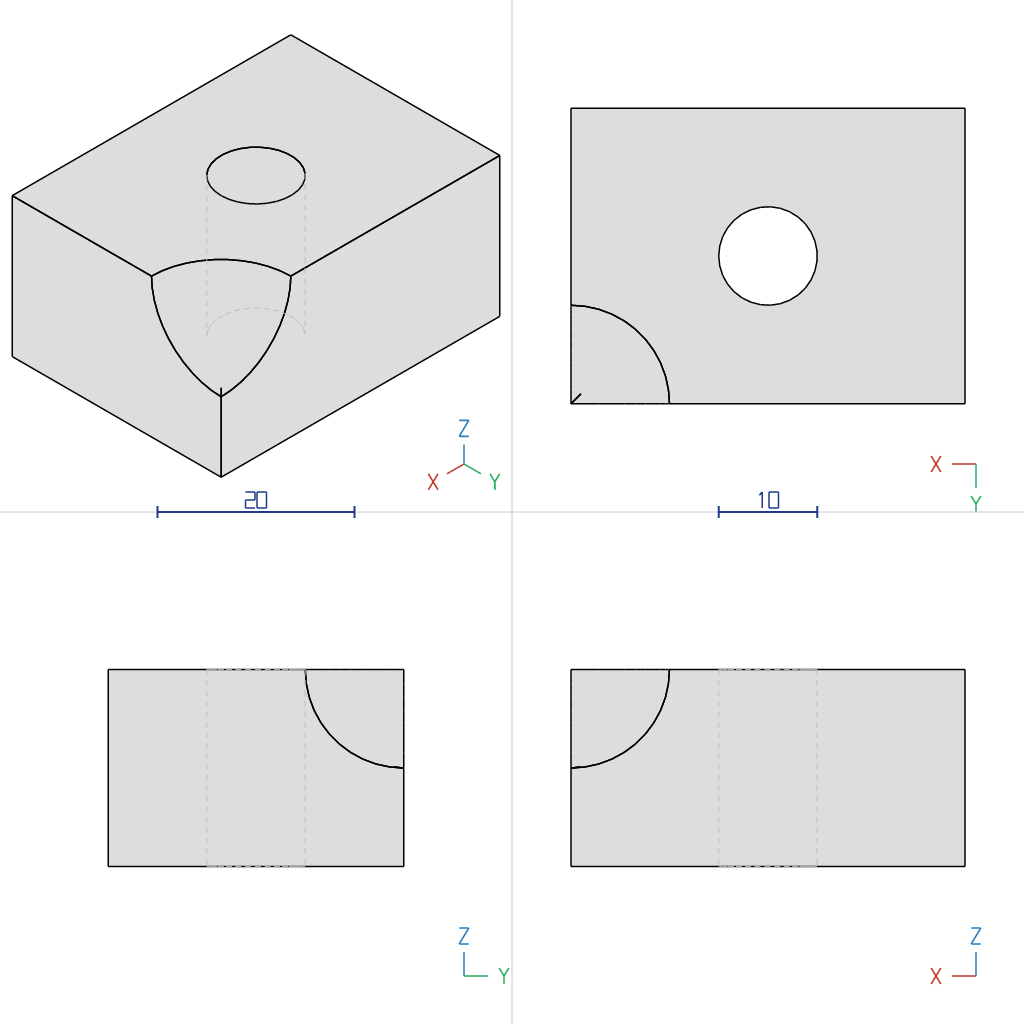
Fixed 4-view multiview PNG for LLM-driven design loops.
//! Fixed 4-view multiview PNG for LLM-driven design loops.
//!
//! A single call to `Solid::write_multiview_png` produces a 1024×1024 PNG that lays out
//! 4 views — ISO plus the axis cyclic order (+X / +Y / +Z) — at the same scale. With no
//! parameters to tune, Solid maps 1:1 to an image, which suits state-snapshot rendering
//! for LLMs and automated design loops.

use cadrum::{DVec3, Solid};

fn main() -> Result<(), cadrum::Error> {
	let example_name = std::path::Path::new(file!()).file_stem().unwrap().to_str().unwrap();

	let block = Solid::cube(DVec3::ZERO, DVec3::new(40.0, 30.0, 20.0)).translate(-DVec3::new(20.0, 15.0, 10.0));
	let hole = Solid::cylinder(5.0, DVec3::Z * 30.0).translate(-DVec3::Z * 15.0);
	// Axis-orientation check: carve only the +X+Y+Z corner with a sphere.
	// Which corner the notch appears in on each panel uniquely confirms the gnomon's direction.
	let corner_cut = Solid::sphere(10.0).translate(DVec3::new(20.0, 15.0, 10.0));
	let part: Solid = (&block - &hole - &corner_cut).build()?;

	part.write_multiview_png(&mut std::fs::File::create(format!("{example_name}.png")).unwrap())?;
	let mesh = Solid::mesh([&part], Default::default())?;
	mesh.write_stl(&mut std::fs::File::create(format!("{example_name}.stl")).unwrap())?;
	mesh.write_gltf_binary(&mut std::fs::File::create(format!("{example_name}.glb")).unwrap())?;

	println!("wrote {example_name}.png / {example_name}.stl / {example_name}.glb");
	Ok(())
}
Output: 15_multiview.png | 15_multiview.glb | 15_multiview.stl