Sweep
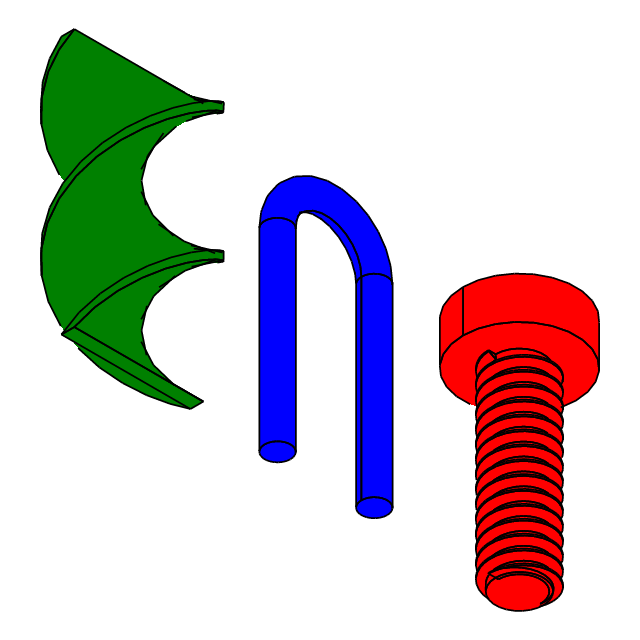
Sweep showcase: M2 screw (helix spine) + U-shaped pipe (line+arc+line spine)
//! Sweep showcase: M2 screw (helix spine) + U-shaped pipe (line+arc+line spine)
//! + twisted ribbon (`Auxiliary` aux-spine mode).
//!
//! `ProfileOrient` controls how the profile is oriented as it travels along the spine:
//!
//! - `Fixed`: profile is parallel-transported without rotating. Cross-sections
//!   stay parallel to the starting orientation. Suited for straight extrusions;
//!   on a curved spine the profile drifts off the tangent and the result breaks.
//! - `Torsion`: profile follows the spine's principal normal (raw Frenet–Serret
//!   frame). Suited for constant-curvature/torsion curves like helices and for
//!   3D free curves where the natural twist should carry into the profile.
//!   Fails near inflection points where the principal normal flips.
//! - `Up(axis)`: profile keeps `axis` as its binormal — at every point the
//!   profile is rotated around the tangent so one in-plane axis stays in the
//!   tangent–`axis` plane. Suited for roads/rails/pipes that must preserve a
//!   gravity direction. On a helix, `Up(helix_axis)` is equivalent to `Torsion`.
//!   Fails when the tangent becomes parallel to `axis`.
//! - `Auxiliary(aux_spine)`: profile's tracked axis points from the main spine
//!   toward a parallel auxiliary spine. Arbitrary twist control — e.g. a
//!   helical `aux_spine` on a straight `spine` produces a twisted ribbon.

use cadrum::{DVec3, Edge, Error, ProfileOrient, Solid};

// ==================== Component 1: M2 ISO screw ====================

fn build_m2_screw() -> Result<Solid, Error> {
	let r = 1.0;
	let h_pitch = 0.4;
	let h_thread = 6.0;
	let r_head = 1.75;
	let h_head = 1.3;
	// ISO M thread fundamental triangle height: H = √3/2 · P (sharp 60° triangle).
	let r_delta = 3f64.sqrt() / 2.0 * h_pitch;

	// Helix spine at the root radius. x_ref=+X anchors the start at (r-r_delta, 0, 0).
	let helix = Edge::helix(r - r_delta, h_pitch, h_thread, DVec3::Z, DVec3::X)?;

	// Closed triangular profile in local coords (x: radial, y: along helix tangent).
	let profile = Edge::polygon(&[DVec3::new(0.0, -h_pitch / 2.0, 0.0), DVec3::new(r_delta, 0.0, 0.0), DVec3::new(0.0, h_pitch / 2.0, 0.0)])?;

	// Align profile +Z with the helix start tangent, then translate to the start point.
	let profile: Vec<Edge> = profile.into_iter().map(|e| e.align_z(helix.start_tangent(), helix.start_point()).translate(helix.start_point())).collect();

	// Sweep along the helix. Up(+Z) ≡ Torsion for a helix and yields a correct thread.
	let thread = Solid::sweep(&profile, &[helix], ProfileOrient::Up(DVec3::Z))?;

	// Reconstruct the ISO 68-1 basic profile (trapezoid) from the sharp triangle:
	//   union(shaft) fills the bottom H/4 → P/4-wide flat at the root
	//   intersect(crest) trims the top H/8 → P/8-wide flat at the crest
	let shaft = Solid::cylinder(r - r_delta * 6.0 / 8.0, DVec3::Z * h_thread);
	let crest = Solid::cylinder(r - r_delta / 8.0, DVec3::Z * h_thread);
	let thread_shaft: Solid = ((&thread + &shaft) * &crest).build()?;

	// Stack the flat head on top. Screw ends up centered on the origin.
	let head = Solid::cylinder(r_head, DVec3::Z * h_head).translate(DVec3::Z * h_thread);
	let res: Solid = (&thread_shaft + &head).build()?;
	Ok(res.color("red"))
}

// ==================== Component 2: U-shaped pipe ====================

fn build_u_pipe() -> Result<Solid, Error> {
	let pipe_radius = 0.4;
	let leg_length = 6.0;
	let gap = 3.0;
	let half_gap = gap / 2.0;
	let bend_radius = half_gap;

	// U-shaped path in the XZ plane, centered on origin in X: A↑B ⌒ C↓D.
	let a = DVec3::new(-half_gap, 0.0, 0.0);
	let b = DVec3::new(-half_gap, 0.0, leg_length);
	let arc_mid = DVec3::new(0.0, 0.0, leg_length + bend_radius);
	let c = DVec3::new(half_gap, 0.0, leg_length);
	let d = DVec3::new(half_gap, 0.0, 0.0);

	// Spine wire: line → semicircle → line.
	let up_leg = Edge::line(a, b)?;
	let bend = Edge::arc_3pts(b, arc_mid, c)?;
	let down_leg = Edge::line(c, d)?;

	// Circular profile in XY (normal +Z) translated to the spine start `a`.
	// Spine tangent at `a` is +Z, so the XY-plane circle is already aligned.
	let profile = Edge::circle(pipe_radius, DVec3::Z)?.translate(a);

	// Up(+Y) fixes the binormal to the path-plane normal, avoiding Frenet
	// degeneracy on the straight segments.
	let pipe = Solid::sweep(&[profile], &[up_leg, bend, down_leg], ProfileOrient::Up(DVec3::Y))?;
	Ok(pipe.translate(DVec3::X * 6.0).color("blue"))
}

// ==================== Component 3: Auxiliary-spine twisted ribbon ====================

// Sweeping a straight spine with `Auxiliary(&[helix])` rotates the tracked
// axis of the profile at each point to face the corresponding helix point.
// A pitch=h helix makes exactly one 360° turn over [0, h], so a flat
// rectangular profile becomes a ribbon twisted once. With `Fixed` or
// `Torsion` the profile wouldn't rotate along a straight spine — visible
// twist is therefore proof that Auxiliary is in effect.
fn build_twisted_ribbon() -> Result<Solid, Error> {
	let h = 8.0;
	let aux_r = 3.0;

	let spine = Edge::line(DVec3::ZERO, DVec3::Z * h)?;
	let aux = Edge::helix(aux_r, h, h, DVec3::Z, DVec3::X)?;

	// Flat rectangle (10:1 aspect) — circles or squares wouldn't reveal any twist.
	let profile = Edge::polygon(&[DVec3::new(-2.0, -0.2, 0.0), DVec3::new(2.0, -0.2, 0.0), DVec3::new(2.0, 0.2, 0.0), DVec3::new(-2.0, 0.2, 0.0)])?;

	let ribbon = Solid::sweep(&profile, &[spine], ProfileOrient::Auxiliary(&[aux]))?;
	Ok(ribbon.translate(DVec3::X * 12.0).color("green"))
}

// ==================== main: side-by-side layout ====================
//
// Each builder places its component at its final world position (screw at
// origin, U-pipe at x=6, ribbon at x=12) and applies its color, so main
// just concatenates them.

fn main() -> Result<(), Error> {
	let example_name = std::path::Path::new(file!()).file_stem().unwrap().to_str().unwrap();
	let all = [build_m2_screw()?, build_u_pipe()?, build_twisted_ribbon()?];

	Solid::write_step(&all, &mut std::fs::File::create(format!("{example_name}.step")).unwrap())?;

	// Helical threads have dense hidden lines that clutter the output; disable them.
	let mesh = Solid::mesh(&all, Default::default())?;
	let scene = mesh.scene(cadrum::SceneOption { view: DVec3::new(1.0, 1.0, -1.0), hidden_edges: false, ..Default::default() });
	scene.write_svg(&mut std::fs::File::create(format!("{example_name}.svg")).unwrap())?;
	scene.write_png([640, 640], &mut std::fs::File::create(format!("{example_name}.png")).unwrap())?;
	mesh.write_stl(&mut std::fs::File::create(format!("{example_name}.stl")).unwrap())?;
	mesh.write_gltf_binary(&mut std::fs::File::create(format!("{example_name}.glb")).unwrap())?;

	println!("wrote {example_name}.step / {example_name}.svg / {example_name}.png ({} solids)", all.len());
	Ok(())
}
Output: 07_sweep.png | 07_sweep.step | 07_sweep.glb | 07_sweep.stl | 07_sweep.svg